

GitHub Spec Kit — AI Agent Specification Workflow
Overview
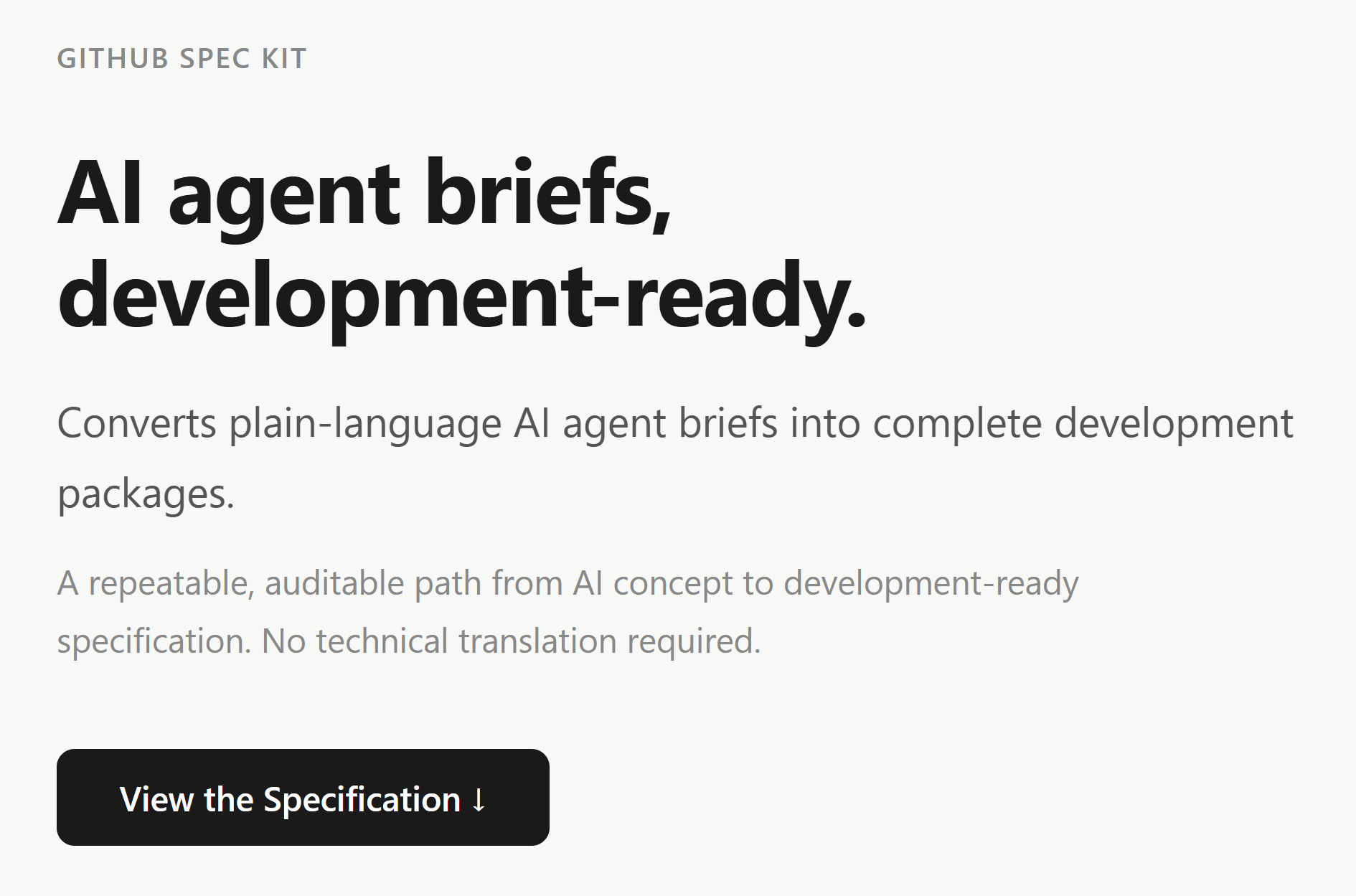
Most AI agent concepts stall between business intent and engineering execution. Leaders describe what they want an agent to do, but the translation into structured requirements, technical architecture, and actionable tasks requires back-and-forth that slows delivery and introduces misalignment. GitHub Spec Kit is an open-source workflow that converts plain-language AI agent briefs into complete development packages. It produces specifications, implementation plans, data models, and task breakdowns with acceptance criteria. The workflow was built as an instructive example and can be deployed and configured in any environment.
Check it out here.
My Role
I configured and deployed GitHub Spec Kit to demonstrate its full capability. This included selecting an instructive use case, running the brief through the complete workflow, and producing the demonstration agent and output package. The demonstration reflects the governance methodology I applied in a large-scale enterprise AI program to assess and govern 70 AI use cases.
What I Delivered
Workflow Configuration and Deployment
I configured the Spec Kit workflow and ran a complete agent brief through its three stages: specify, plan, and task. The specify stage produces user stories, acceptance criteria, and functional requirements structured for engineering handoff. The plan stage generates technical architecture and phasing strategy. The task stage breaks the specification into actionable work items, each with a clear definition of done.
Complete Documentation Package
The deployed workflow produces a full documentation package that gives development teams everything they need to begin building without additional translation. Each specification produces a core requirements document, research and design rationale, an implementation plan, a data model with entity definitions and relationships, a quick start guide, and a detailed task breakdown.
Demonstration Agent
I selected and ran a Chief Estimator Risk Agent for a USD 285M Regional Acute Care Hospital Expansion project as the demonstration use case. The output includes an executive-ready risk assessment that surfaces nine estimate risks with historical evidence, likelihood and impact ratings, and mitigation strategies.
Enterprise Governance Application
The demonstration illustrates how the workflow gives non-engineering leaders a repeatable, auditable path from AI concept to development-ready specification. This removes the requirement for technical translation at every step and supports the kind of structured intake process needed when governing large portfolios of AI use cases.
Impact
Demonstrates a complete path from plain-language agent brief to development-ready specification package
Produces structured requirements, implementation plans, data models, and task breakdowns with acceptance criteria
Illustrates the governance methodology applied to assess and govern 70 AI use cases in an enterprise AI program
Demonstrated end to end with a USD 285M construction risk agent producing executive-ready output
Free, open-source resource that can be configured and deployed in any environment